
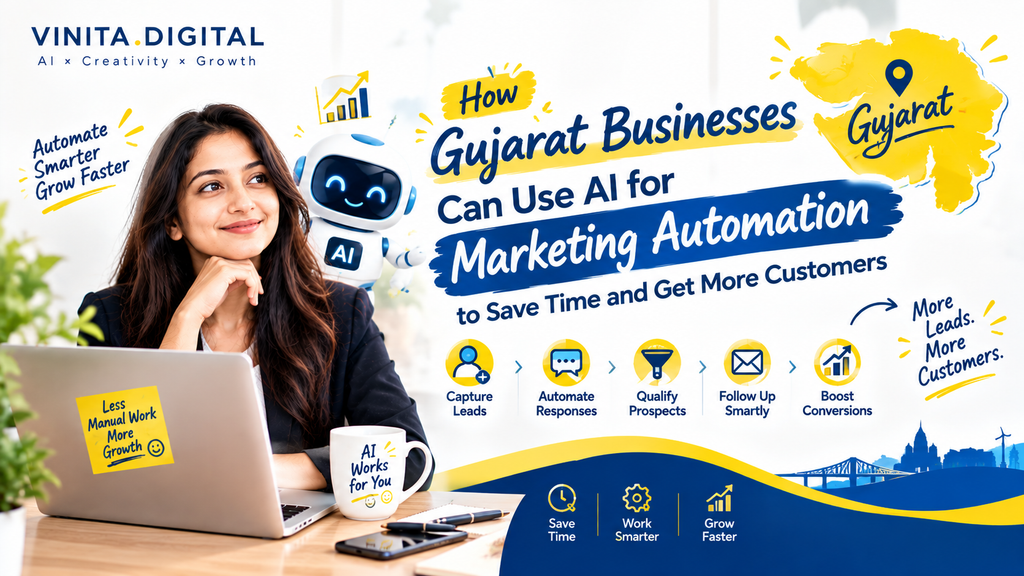
AI marketing automation in Gujarat is helping businesses reduce repetitive marketing work, respond faster to customers, manage leads, and build more consistent marketing systems.
Instead of spending hours manually replying to every enquiry, following up with every lead, creating every campaign, or checking every marketing report, businesses can use AI to automate parts of the process while keeping people in control of important decisions.
For Gujarat businesses, this can be especially useful when the same small team is handling sales, marketing, customer support, social media, and daily operations.
The goal is not to automate everything.
The goal is to automate the repetitive work so you have more time for the work that actually needs a human touch.
What Is AI Marketing Automation?
AI marketing automation means using artificial intelligence and automation tools to handle repetitive marketing and customer communication tasks.
Traditional automation follows fixed rules.
For example:
If someone fills out a form, send an email.
AI-powered automation can go further.
It can help businesses understand customer questions, personalize responses, identify patterns, assist with content creation, qualify enquiries, and support campaign optimization.
A simple AI marketing system can look like this:
Visitor → Lead → AI Response → Qualification → Follow-Up → Sales Conversation → Customer
The exact process depends on the business.
Why Gujarat Businesses Should Consider AI Marketing Automation
Marketing can become difficult when a business starts getting more enquiries.
A business may have:
- Website enquiries
- WhatsApp messages
- Instagram messages
- Facebook enquiries
- Google Ads leads
- Email enquiries
- Phone calls
- Repeat customers
- Existing customer databases
Managing all of this manually can take a lot of time.
AI marketing automation can help connect different parts of the customer journey.
For example, imagine someone visits your website at 11:30 PM and sends an enquiry.
Instead of waiting until the next morning, an automated system can acknowledge the enquiry, answer basic questions, collect useful information, and notify the business owner or sales team.
That does not mean AI closes every sale.
It means the business has a better chance of responding while the customer’s interest is still fresh.
1. Automate Lead Capture
The first step is making it easier for potential customers to become leads.
Businesses can use:
- Website forms
- Landing pages
- Social media messages
- Lead advertisements
- Chat systems
- Appointment forms
- Call-back requests
AI can help organize information collected from these channels.
For example, instead of receiving a basic message saying:
“I want more information.”
A structured process can collect:
- Name
- Business type
- Service required
- Location
- Budget range
- Preferred contact method
- Expected timeline
This gives the sales team more useful information before the first conversation.
2. Use AI to Respond Faster
Speed matters when someone is interested in a product or service.
Customers may contact a business outside normal working hours.
AI-powered customer communication can help answer common questions and provide basic information.
Meta announced Business AI on WhatsApp for eligible small businesses in India, including capabilities for answering customer questions, capturing leads, booking appointments, and supporting sales conversations. Meta says businesses remain able to take over conversations when a human response is needed.
That human handoff is important.
AI should handle suitable repetitive conversations.
A person should handle situations that require judgment, empathy, negotiation, or specialized expertise.
3. Automate Lead Qualification
Not every lead has the same potential.
Some people are ready to buy.
Others are simply researching.
Some may have the wrong requirements.
AI-assisted systems can help categorize leads based on information such as:
- Service requirement
- Location
- Budget
- Business size
- Purchase timeline
- Previous interaction
- Product interest
For example:
Hot lead: Wants to start this week.
Warm lead: Interested but needs more information.
Cold lead: Researching for a future requirement.
This helps sales teams decide where to spend their time.
4. Automate Follow-Ups
One of the most common marketing problems is simply forgetting to follow up.
A potential customer may say:
“I’ll get back to you.”
Then the conversation disappears.
Automation can help create follow-up reminders or messages based on the customer’s journey.
For example:
Day 1: Send information.
Day 3: Follow up with a helpful answer.
Day 7: Share a useful case study or resource.
Day 14: Ask whether they still need help.
The exact timing should depend on the business and customer journey.
Follow-ups should also be useful.
Nobody wants to receive five identical sales messages.
5. Automate WhatsApp Marketing
WhatsApp is an important customer communication channel for many Indian businesses.
AI and automation can help businesses manage repetitive conversations, FAQs, product information, appointment requests, and lead follow-ups.
Meta’s Business AI announcement for India describes support for customer questions, product recommendations, lead capture, appointments, and sales-related conversations on WhatsApp for eligible businesses.
For a local business, this could create a simple journey:
Instagram → WhatsApp → AI Response → Lead Qualification → Human Sales Call
That is much more useful than simply collecting followers.
6. Automate Social Media Work
AI can help reduce the time required for social media planning.
A business can use AI to assist with:
- Content ideas
- Caption drafts
- Content calendars
- Short-form video concepts
- Post variations
- Audience research
- Repurposing existing content
- Performance summaries
But automation should not mean publishing random AI-generated content every day.
Your brand still needs:
- Original ideas
- Real experiences
- Local knowledge
- Human opinions
- Customer stories
- Useful information
AI should make content production easier.
It should not remove the personality of the brand.
7. Use AI for Email Marketing Automation
Email automation can help businesses stay connected with potential and existing customers.
A simple sequence could be:
New subscriber → Welcome email → Educational content → Product/service information → Follow-up → Offer or consultation
AI can assist with subject-line ideas, personalization, content variations, and segmentation.
For example, a business could create different communication paths for:
- New customers
- Existing customers
- High-intent leads
- Previous customers
- People who requested information
- People who have not purchased yet
This makes communication more relevant.
8. Automate Advertising Optimization
AI is already part of major advertising platforms.
Google Ads Smart Bidding uses Google AI to optimize bids for conversions or conversion value at auction time. Google currently lists strategies such as Maximize conversions, Target CPA, Maximize conversion value, and Target ROAS.
This means businesses do not necessarily need to manually adjust every bid for every auction.
But automation works best when the underlying marketing setup is good.
Businesses still need:
- Clear goals
- Accurate conversion tracking
- Good landing pages
- Relevant offers
- Strong creative
- Correct audience targeting
- Quality lead handling
AI cannot fix a broken marketing funnel by itself.
9. Create Automated Lead Nurturing
Some customers are not ready to buy immediately.
That does not mean they should be forgotten.
Lead nurturing keeps the business connected until the customer becomes ready.
For example, a real-estate business might send:
- Property guides
- Local market information
- New property alerts
- Financing information
- Frequently asked questions
A marketing agency might share:
- Marketing tips
- Case studies
- Campaign insights
- Educational content
- Service information
AI can help personalize and manage these communication sequences.
10. Use AI to Personalize Marketing
Personalization does not always mean using someone’s name.
It means showing information that matches what the person actually needs.
For example:
A restaurant customer may care about menus and reservations.
A real-estate customer may care about property availability.
A manufacturing buyer may care about specifications and pricing.
A healthcare business may need appointment information.
AI can help businesses organize customer information and create more relevant communication.
The result should feel helpful rather than intrusive.
11. Automate Customer Support
Businesses often receive the same questions repeatedly.
Examples include:
- What are your prices?
- Where are you located?
- What are your working hours?
- How long does delivery take?
- Do you provide this service?
- How can I book an appointment?
- What documents are required?
These questions can often be handled through structured automation or AI assistance.
This allows the team to spend more time on complex customer needs.
12. Automate Reporting
Marketing data can become confusing when it comes from multiple platforms.
AI-assisted reporting can help summarize information from:
- Google Ads
- Meta Ads
- Website analytics
- Search performance
- Social media
- Lead forms
- CRM systems
Instead of looking at dozens of numbers, a business owner can focus on questions such as:
How many leads came in?
Which campaign generated them?
Which leads became customers?
What did each customer cost to acquire?
Which marketing channel produced the best business results?
The important part is connecting reporting to business outcomes.
13. Build an AI-Powered Marketing Funnel
A useful AI marketing automation system can connect the entire journey.
Step 1: Attract
Use:
- SEO
- AEO
- GEO
- Social media
- Paid advertising
- Content marketing
Step 2: Capture
Use:
- Website forms
- Landing pages
- Lead forms
- Calls
- Appointment systems
Step 3: Understand
Collect relevant information about the customer.
Step 4: Qualify
Identify which enquiries need immediate attention.
Step 5: Nurture
Send useful information to leads that are not ready yet.
Step 6: Convert
Move qualified leads toward a sales conversation.
Step 7: Retain
Continue communicating with customers after the purchase.
This creates a connected marketing system instead of isolated campaigns.
14. AI Marketing Automation for Small Businesses
Small businesses do not need a huge technology stack.
In fact, starting small is often better.
A local business could begin with:
Website + WhatsApp + CRM + Email + Analytics
Then add more automation as the business grows.
For example:
Local Service Business
Website enquiry
↓
Automatic acknowledgement
↓
Lead qualification
↓
Sales call
↓
Proposal
↓
Follow-up
↓
Customer
E-commerce Business
Social media
↓
Website
↓
Product interaction
↓
Remarketing
↓
Purchase
↓
Customer follow-up
Professional Service Business
Content
↓
Website
↓
Consultation request
↓
Qualification
↓
Appointment
↓
Consultation
↓
Client
The system should match the business.
15. AI Automation for Gujarat’s Growing Businesses
Gujarat has businesses across many industries, including:
- Manufacturing
- Textiles
- Jewellery
- Retail
- Education
- Healthcare
- Real estate
- Hospitality
- Professional services
- E-commerce
- Local services
- Startups
Each industry has a different customer journey.
A manufacturing company may need qualified B2B enquiries.
A jewellery business may need product discovery and WhatsApp conversations.
A real-estate business may need lead qualification and follow-up.
A coaching business may need appointment booking and lead nurturing.
AI automation should therefore be designed around the actual customer journey.
16. What Should You Automate First?
If your business is new to AI automation, do not try to automate everything.
Start with repetitive tasks.
A simple priority list is:
First
Automate lead capture.
Second
Automate basic customer responses.
Third
Automate follow-ups.
Fourth
Automate lead organization and qualification.
Fifth
Automate reporting.
Sixth
Improve advertising and content workflows.
This approach makes it easier to understand what is actually working.
17. What Should NOT Be Fully Automated?
Some things still need people.
Avoid fully automating:
- Important negotiations
- Sensitive customer complaints
- High-value sales conversations
- Complex strategy decisions
- Brand positioning
- Creative direction
- Crisis communication
- Important business decisions
AI can assist.
The human should remain responsible for the final decision.
18. Common AI Marketing Automation Mistakes
Automating Before Understanding the Funnel
If you do not know how customers currently move through your business, automation can create more confusion.
Using Too Many Tools
More tools do not automatically create better marketing.
A simple connected system can be more useful.
Sending Generic AI Messages
Customers can quickly recognize repetitive messages.
Use AI to improve relevance rather than increase message volume.
Ignoring Conversion Tracking
Automation needs reliable data.
Google recommends accurate conversion data when using Smart Bidding and other automated advertising approaches.
Removing Human Support
Customers should have a clear way to reach a person when they need one.
Measuring Activity Instead of Results
More messages do not necessarily mean more customers.
Track meaningful outcomes.
19. How to Measure AI Marketing Automation
Useful metrics can include:
- Number of leads
- Qualified leads
- Lead response time
- Conversion rate
- Cost per lead
- Customer acquisition cost
- Appointment rate
- Sales conversion rate
- Revenue from campaigns
- Customer retention
The right metrics depend on the business model.
A business should not automate something simply because it can.
Automate what improves the customer journey or reduces unnecessary work.
20. The Future of AI Marketing in Gujarat
AI marketing is moving beyond content generation.
Businesses are increasingly using AI across:
- Customer communication
- Advertising
- Lead management
- Content creation
- Personalization
- Reporting
- Customer support
- Sales workflows
Meta has also introduced Business Agent capabilities designed to help businesses handle customer interactions and provide personalized experiences across its business ecosystem.
This suggests that AI will increasingly become part of everyday business operations rather than being used only for writing content.
The businesses that benefit most will not necessarily be the ones using the most AI tools.
They will be the ones using AI for the right problems.
How VINITA DIGITAL Can Help
At VINITA DIGITAL, the focus is not simply on adding AI tools to your marketing.
The goal is to build a marketing system that connects strategy, content, search, social media, advertising, lead generation, automation, and customer journeys.
AI can help businesses move faster.
But strategy decides where to go.
Creativity makes the brand memorable.
Data shows what is working.
And human understanding keeps the marketing relevant.
For Gujarat businesses, the opportunity is to combine all four.
AI × Creativity × Growth
That is where modern digital marketing becomes more than just posting content or running ads.
Frequently Asked Questions
What is AI marketing automation?
AI marketing automation uses artificial intelligence and automated workflows to assist with repetitive marketing and customer tasks such as lead capture, responses, follow-ups, content workflows, qualification, and reporting.
Is AI marketing automation useful for small businesses?
Yes. Small businesses can start with simple workflows such as automated lead capture, customer FAQs, appointment booking, and follow-ups rather than building a complex system.
Can AI generate leads automatically?
AI can assist with lead generation through advertising, content, chat systems, landing pages, lead forms, and automated customer conversations. However, lead quality depends on the offer, audience, marketing strategy, and sales process.
Can AI automate WhatsApp customer conversations?
Eligible businesses in India can use Business AI on WhatsApp for capabilities including answering customer questions, recommending products, capturing leads, booking appointments, and supporting sales conversations.
Does AI replace a marketing team?
Not necessarily. AI can automate repetitive work and assist teams with analysis, content, communication, and campaign optimization. Human strategy, creativity, judgment, and relationship-building remain important.
How much does AI marketing automation cost?
The cost depends on the number of tools, channels, integrations, workflows, and level of customization required. A small business can start with a few simple automations and expand gradually.
What should a business automate first?
Start with repetitive, measurable tasks such as lead capture, basic customer responses, follow-ups, appointment reminders, and reporting.
Is AI marketing automation the same as digital marketing?
No.
Digital marketing is the broader discipline.
AI marketing automation is one part of modern digital marketing that helps automate and improve specific workflows.
Final Takeaway
AI marketing automation is not about making marketing completely automatic.
It is about making marketing smarter, faster, and more consistent.
For Gujarat businesses, even a few well-designed automations can reduce repetitive work, improve lead response, and create a smoother customer journey.
Start small.
Measure the results.
Keep the human connection.
Then scale what works.
The future of marketing is not human versus AI.
It is humans using AI intelligently.
Explore AI-powered digital marketing services at vinitadigital.com.